The Complete IPTC Guide for Website Owners
PART 1: WHAT IS IPTC? IPTC = International Press Telecommunications Council Think of IPTC metadata as a “digital birth certificate” permanently attached...
-
by
-
Feb 12, 2026
PART 1: WHAT IS IPTC?
IPTC = International Press Telecommunications Council
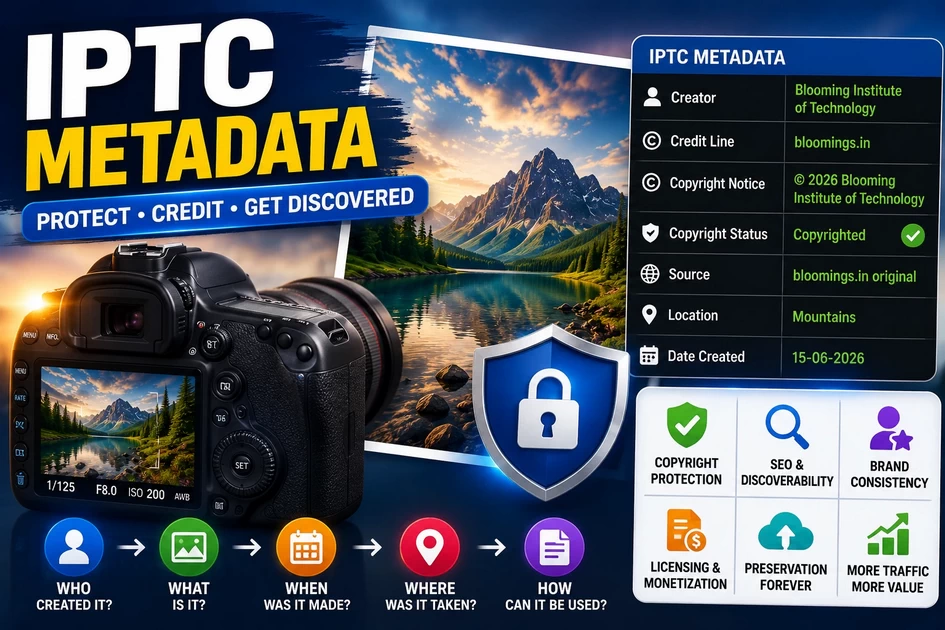
Think of IPTC metadata as a “digital birth certificate” permanently attached to your image file.
📌 Simple Definition:
IPTC is standardized information embedded inside an image file that answers:
-
WHO created it?
-
WHAT is it?
-
WHEN was it made?
-
WHERE was it taken?
-
HOW can it be used?
🎯 Real-Life Analogy:
IPTC is like a luggage tag on a suitcase.
Without a tag: Your bag is just a black suitcase. If lost, nobody knows who owns it or where it belongs.
With a tag: Name, address, destination, contact info — the bag can be returned, tracked, and handled properly.
Your image without IPTC is that untagged suitcase.
PART 2: WHY USE IPTC? (BENEFITS)
✅ 1. Copyright Protection
-
Proves ownership in legal disputes
-
Machine-readable “Copyrighted” status
-
Clear usage terms
✅ 2. SEO & Discoverability
-
Google reads IPTC for image search ranking
-
Images appear for relevant keywords
-
Higher click-through rates
✅ 3. Brand Consistency
-
Every image carries your credit line
-
Prevents misattribution
-
Professional appearance
✅ 4. Licensing & Monetization
-
Stock agencies require IPTC
-
Clear terms for buyers
-
Automated rights management
✅ 5. Preservation
-
Metadata stays with file forever
-
Survives downloads, re-uploads
-
Digital provenance trail
🎯 Real-Life Analogy:
IPTC is like a museum label next to a painting.
Without label: Just a beautiful artwork. Who painted it? When? What’s it called? Is it in the public domain? Nobody knows.
With label: Artist, title, date, medium, ownership, exhibition history — the painting has context, value, and authority.
PART 3: THE “WITHOUT IPTC” PROBLEM
📸 IMAGE A: NO IPTC METADATA
| Field | Value |
|---|---|
| Creator | (blank) |
| Copyright | (blank) |
| Credit | (blank) |
| Copyright Status | Unknown |
What this means:
-
Anyone can download and use it
-
No legal recourse for unauthorized use
-
Google doesn’t know who created it
-
Looks unprofessional
-
Stock agencies will reject it
🎯 Real-Life Analogy:
An image without IPTC is like cash on the street.
If you find $100 on the sidewalk with no name, no wallet, no identifier — it’s yours now. The original owner has no way to prove it was theirs.
PART 4: HOW TO CHECK METADATA (EXIF TOOL)
METHOD A: Check JPEG from Your Computer
Step-by-Step:
-
Go to exif.tools website
-
Click “Choose File” under “View File Metadata via Upload”
-
Select your JPEG image
-
View all EXIF, IPTC, XMP data
What you’ll see WITHOUT IPTC:
text
Creator: (not set)
Copyright: (not set)
Credit: (not set)
Copyright Status: Unknown
What you’ll see WITH IPTC:
text
Creator: Blooming Institute of Technology
Copyright: © 2026 Blooming Institute of Technology
Credit: bloomings.in
Copyright Status: Copyrighted
METHOD B: Check Live Image from Your Website URL
Step-by-Step:
-
Go to your website
-
Right-click any image → “Copy image address”
-
Go to exif.tools
-
Paste URL in “View File Metadata via URL” section
-
Click “Get URL”
Why this matters:
-
Tests if your server strips metadata
-
Verifies live website images are protected
-
Quick audit of your entire media library
PART 5: WHAT TO TYPE — THE EXACT FIELDS
📋 IPTC CORE — ESSENTIAL FIELDS ONLY
| Field | What to Type | Why |
|---|---|---|
| Creator | Blooming Institute of Technology |
Who made it? |
| Credit Line | bloomings.in |
How to give credit? |
| Copyright Notice | © 2026 Blooming Institute of Technology |
Legal copyright statement |
| Copyright Status | ✅ SELECT “Copyrighted” (dropdown) | Machine-readable rights flag |
| Source | bloomings.in original |
Original distributor |
🧠 Memory Trick:
“Name, Credit, Notice, Status — IPTC Core is no longer a fuss!”
-
Name = Creator
-
Credit = Credit Line
-
Notice = Copyright Notice
-
Status = Copyrighted ✅
PART 6: THE WEBP PROBLEM — IPTC BREAKS HERE
❌ WHAT HAPPENS:
JPEG + PNG = ✅ Full IPTC support (binary blocks)
⬇️ CONVERT TO WEBP
WEBP = ❌ No native IPTC block support
Result: Legacy IPTC-IIM data is DROPPED during conversion
✅ THE SOLUTION:
WebP supports XMP — which is where modern IPTC lives.
Instead of writing to IPTC block, write to XMP-iptcCore:
| Correct Tag | Instead Of |
|---|---|
XMP-iptcCore:Creator |
❌ IPTC:By-line |
XMP-photoshop:Credit |
❌ IPTC:Credit |
XMP-dc:Rights |
❌ IPTC:CopyrightNotice |
XMP-xmpRights:Marked |
❌ IPTC:CopyrightStatus |
🔧 FIX COMMAND (ExifTool):
bash
exiftool -overwrite_original
  -XMP-iptcCore:Creator="Blooming Institute of Technology"
  -XMP-photoshop:Credit="bloomings.in"
  -XMP-dc:Rights="© 2026 Blooming Institute of Technology"
  -XMP-xmpRights:Marked=True
  *.webp
🎯 Real-Life Analogy:
JPEG to WebP conversion is like moving from an old filing cabinet to a new digital system.
Old cabinet (JPEG): Had a drawer labeled “IPTC” — you put all your copyright forms there.
New system (WebP): No “IPTC” drawer. But there IS a “XMP” drawer with labeled folders.
You didn’t lose your forms — you just need to put them in the correct drawer.
PART 7: SOFTWARE COMPARISON — ACDSee vs Adobe Bridge
| Feature | Adobe Bridge | ACDSee |
|---|---|---|
| WebP IPTC/XMP Writing | ✅ YES (via XMP) | ❌ NO (confirmed) |
| Batch Metadata | ✅ Excellent | ✅ Good |
| Free | ✅ Yes | ❌ Paid |
| Auto-save | ✅ Instant | ✅ Instant |
| Integration | ✅ Photoshop, Lightroom | ⭐ Standalone |
| Learning Curve | ⭐ Moderate | ⭐ Easy |
| Platform | Win + Mac | Win + Mac |
🏆 WINNER: Adobe Bridge
Why Bridge Wins for WebP IPTC:
-
FREE — no cost
-
WRITES XMP to WebP — confirmed working
-
Adobe ecosystem — seamless with Creative Cloud
-
Industry standard — used by museums, libraries, stock agencies
-
Verified — your own EXIF.tools output shows “Adobe Bridge 2026”
🎯 Real-Life Analogy:
Bridge is the professional’s toolbox; ACDSee is the homeowner’s toolkit.
Both can hammer a nail. But when you need precision, reliability, and industry-standard results, you use the professional tools.
PART 8: HOW TO INSTALL ADOBE BRIDGE
METHOD A: With Creative Cloud (Recommended)
Step 1: Download Creative Cloud desktop app
-
Click “Download Creative Cloud”
-
Install and launch
Step 2: Install Bridge
-
Open Creative Cloud app
-
Click “Apps” tab
-
Find “Adobe Bridge”
-
Click “Install”
Time: 5-10 minutes
Cost: FREE
METHOD B: Direct Download
Step 1: Visit Adobe Bridge product page
Step 2: Click “Download free trial” (it’s actually free forever)
Step 3: Run installer
✅ VERIFY INSTALLATION:
-
Open Bridge
-
Navigate to any folder with images
-
Click an image → Metadata panel
-
If you see IPTC fields — you’re ready
PART 9: HOW AI & GOOGLE REACT TO IPTC
🧠 WITHOUT IPTC:
| Platform | What Happens |
|---|---|
| Google Images | “Unknown image. No creator data. Low confidence.” |
| AI Training Datasets | “Image with no rights information — treat as public domain?” |
| Stock Agencies | Rejected automatically |
| Social Media | No auto-attribution |
| Visual Search | Poor context understanding |
✅ WITH IPTC:
| Platform | What Happens |
|---|---|
| Google Images | “Image by Blooming Institute. Copyrighted. Show credit line.” |
| AI Training Datasets | “Rights reserved. Request permission.” |
| Stock Agencies | Accepted. Ready for licensing. |
| Social Media | Some platforms auto-extract credit |
| Visual Search | “This image is from bloomings.in — about technology education” |
🎯 Real-Life Analogy — GOOGLE:
Without IPTC: You’re a musician playing on the street with no name tag.
People record you, share the video, it goes viral. Everyone hears your song. Nobody knows it’s YOU.
With IPTC: You’re a signed artist with your name in the song metadata.
Every radio play, every stream, every download — your name appears. Spotify knows. Billboard charts know. Royalties come to YOU.
🎯 Real-Life Analogy — AI:
Without IPTC: You write a brilliant essay and leave it on a park bench.
Someone finds it, publishes it as their own. AI crawls the web, learns from “their” writing, credits them. You’re erased from history.
With IPTC: You publish your essay with your name, date, copyright.
AI reads it. AI cites you. Every LLM trained on your work carries your attribution forward.
PART 10: COMPLETE WORKFLOW SUMMARY
🔁 YOUR DAILY PROCESS:
text
1. CREATE → Take photos, design graphics
2. EDIT → Enhance in Photoshop/Lightroom
3. METADATA → Adobe Bridge → IPTC Core → ALL FIELDS + Copyrighted
4. EXPORT → Save as WebP with -metadata all
5. VERIFY → EXIF.tools → Check URL of live image
6. UPLOAD → Website goes live with protected images
✅ MINIMUM VIABLE IPTC:
| Field | Status |
|---|---|
| Creator | ✅ REQUIRED |
| Credit Line | ✅ REQUIRED |
| Copyright Notice | ✅ REQUIRED |
| Copyright Status = Copyrighted | ✅ REQUIRED |
| Source | ⭐ Recommended |
| Rights Usage Terms | ⭐ Recommended |
| Keywords | ⭐ Recommended |
📌 FINAL MEMORY TRICK — “THE BIG 4”
“Who, Credit, Rights, Status”
-
WHO made it? → Creator
-
CREDIT them how? → Credit Line
-
RIGHTS statement? → Copyright Notice
-
STATUS of rights? → Copyrighted ✅
🎯 BOTTOM LINE
| Question | Answer |
|---|---|
| Do I need IPTC? | ✅ YES — non-negotiable |
| What software? | ✅ Adobe Bridge (free, reliable, WebP-compatible) |
| What fields? | ✅ Creator, Credit, Copyright Notice, Copyright Status |
| WebP problem? | ✅ Solved — use XMP-iptcCore tags |
| Google/AI? | ✅ Reads IPTC/XMP — rewards you with credit |
| Your images now? | ⚠️ Missing Copyright Status — FIX TODAY |
-
AboutBIT

You May Also Like
Sign up to receive our latest updates
[mc4wp_form id=3101]
Get in touch
Address
152A, Annavalaivu, Thuvakudimalai, Tiruchirappalli, Tamil Nadu – 620 022
Landmark : Near Post Office
Landmark : Near Post Office
bloomingtutorial@gmail.com
