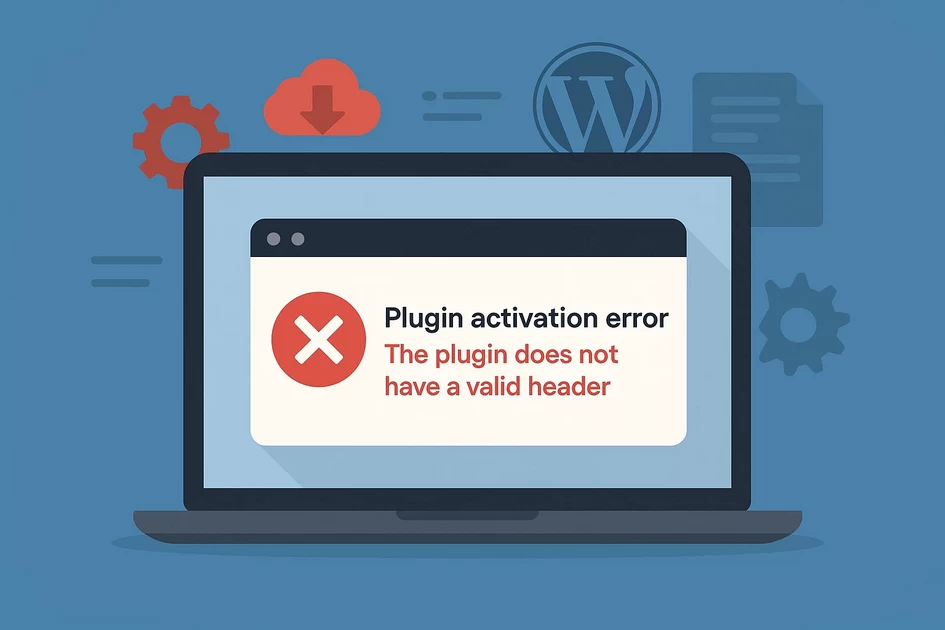
Plugin activation error — “The plugin does not have a valid header”
Short summary:This error means WordPress can’t find a valid plugin header comment in the plugin’s main PHP file. Causes: corrupted/partial...
-
by
-
Dec 12, 2025
Short summary:
This error means WordPress can’t find a valid plugin header comment in the plugin’s main PHP file. Causes: corrupted/partial download, bad ZIP extraction, wrong file moved into plugin folder, BOM/extra whitespace, wrong filename, permissions preventing reading, or a malformed header. Below is a full, copy-pasteable, step-by-step troubleshooting & repair guide (what, why, how), plus what not to do, and SEO metadata.
What is the “plugin header” (quick)
A plugin header is a PHP comment block at the top of the plugin’s main file that tells WordPress the plugin name, author, version, etc. Example minimal header:
<?php
/*
Plugin Name: My Example Plugin
Plugin URI: https://example.com/my-plugin
Description: Short description of plugin.
Version: 1.2.3
Author: Jane Doe
Author URI: https://example.com
Text Domain: my-example-plugin
*/
If WordPress cannot find Plugin Name: in a top-level PHP file (first ~ 8 KB), it shows “does not have a valid header.”
Full step-by-step troubleshooting & fixes
Before you start: Always backup your site (files + DB). Don’t edit live files without a backup.
1) Confirm the exact error and plugin folder
What to do:
- Try activating the plugin from WP admin to reproduce the error and note the plugin folder name.
- Look in
wp-content/plugins/for the plugin directory name.
Why:
- Sometimes the ZIP contains an extra parent folder (e.g.
plugin-1.0/plugin/), so WordPress can’t find the main plugin file where it expects.
How:
# list plugin folder
ls -l /path/to/wordpress/wp-content/plugins/
Fix if wrong folder structure:
- If you see nested folders like
my-plugin-1.0/my-plugin/my-plugin.php, move the correct folder so the main plugin file is insidewp-content/plugins/my-plugin/(not extra nesting).
2) Check for partial or corrupted download
What to do:
- Delete the plugin folder, re-download the plugin ZIP from the official plugin repo, and re-upload/extract carefully.
Why:
- A corrupted or partial ZIP extract may create broken PHP files or missing headers.
How (SSH example):
cd /path/to/wordpress/wp-content/plugins
rm -rf my-plugin                 # remove broken install (backup first if needed)
wget https://downloads.wordpress.org/plugin/my-plugin.latest-stable.zip -O /tmp/my-plugin.zip
unzip /tmp/my-plugin.zip -d /tmp/
# inspect extracted contents to find the real plugin dir, then move
mv /tmp/my-plugin /path/to/wordpress/wp-content/plugins/my-plugin
chown -R www-data:www-data /path/to/wordpress/wp-content/plugins/my-plugin
chmod -R 755 /path/to/wordpress/wp-content/plugins/my-plugin
If you don’t have SSH:
- Use the hosting control panel’s File Manager: delete plugin folder → upload fresh ZIP → extract → ensure extracted folder is directly inside
wp-content/plugins/.
Note: Some hosts or FTP clients corrupt ZIP transfer if using ASCII mode — always use binary mode when transferring ZIPs.
3) Inspect the plugin’s main file header (open the plugin’s main PHP file)
What to do:
- Find the file that should contain the header (common names:
plugin-name.php,index.php, or a file specified in readme). Open the top of the file and confirm the header is present and syntactically correct.
Why:
- If the header is missing or comments were stripped by a bad extraction, WordPress will not recognize the plugin.
How (view first 50 lines):
head -n 50 /path/to/wordpress/wp-content/plugins/my-plugin/my-plugin.php
Look for a properly formed block with Plugin Name:. If it’s missing, the plugin is corrupted or you’re opening the wrong file.
4) Remove BOM / extra whitespace and ensure PHP opening tag is first
What to do:
- Ensure the PHP file begins with
<?phpand no whitespace, no new-lines, no BOM before it.
Why:
- A BOM (Byte Order Mark) or invisible characters before
<?phpcan break PHP parsing or cause WordPress not to detect the header properly.
How:
- Open the file in a code editor (VSCode, Sublime) and set encoding to UTF-8 without BOM. Or use
sed/awkto check/remove BOM.
Check BOM presence:
# show bytes of first 4 characters
xxd -l 4 -g 1 /path/to/plugins/my-plugin/my-plugin.php
Remove BOM (example using awk):
awk 'NR==1{sub(/^\xef\xbb\xbf/,"")}{print}' /path/to/plugins/my-plugin/my-plugin.php > /tmp/tmp.php && mv /tmp/tmp.php /path/to/plugins/my-plugin/my-plugin.php
Also ensure there’s no blank line before <?php.
5) Verify file encoding & line endings
What to do:
- Ensure files are UTF-8 without BOM and use Unix line endings (LF).
Why:
- Some Windows editors or packaging compressions change encoding/line endings; WordPress can still read them but BOM is the main culprit.
How:
- Convert with
dos2unixand confirm withfile:
file /path/to/plugins/my-plugin/my-plugin.php
dos2unix /path/to/plugins/my-plugin/*.php
6) Check plugin files haven’t been renamed / index.php conflicts
What to do:
- Sometimes the main file is renamed to something unexpected, or an
index.phpwith no header exists at top-level and WP reads that first. Make sure the main plugin file contains the header (not a blankindex.php).
Why:
- WP scans all top level files for headers; if header is missing in all, plugin invalid.
How:
- List files and open likely candidates:
ls -1 /path/to/plugins/my-plugin
7) Permissions & ownership checks (so WP/PHP can read the file)
What to do:
- Ensure files are readable by the webserver/PHP user.
Why:
- If files are not readable, WP might fail to parse them.
How:
# common web users: www-data (Debian/Ubuntu), apache (CentOS)
chown -R www-data:www-data /path/to/wordpress/wp-content/plugins/my-plugin
find /path/to/wordpress/wp-content/plugins/my-plugin -type d -exec chmod 755 {} \;
find /path/to/wordpress/wp-content/plugins/my-plugin -type f -exec chmod 644 {} \;
Do NOT use 777.
8) Use WP-CLI to inspect/verify plugin
What to do:
- If you have WP-CLI, use it to list plugins and inspect activation errors.
Why:
- WP-CLI often gives clearer diagnostic messages and can install/activate reliably.
How:
# list plugin files
wp plugin list --path=/path/to/wordpress

# try activating (shows errors)
wp plugin activate my-plugin --path=/path/to/wordpress
If WP-CLI shows same header error, the plugin main file is malformed or missing header.
9) Confirm ZIP packaging from repo (compare checksums if possible)
What to do:
- Re-download from wordpress.org and compare size/checksum with your copy.
Why:
- Rarely, a mirrored repo or network error may deliver corrupted ZIP.
How:
# example
wget -O /tmp/my-plugin.zip https://downloads.wordpress.org/plugin/my-plugin.latest-stable.zip
sha256sum /tmp/my-plugin.zip
# compare with your downloaded version (if you saved it)
sha256sum /tmp/your-copy.zip
If mismatch, re-download and re-install.
10) Reinstall using WordPress admin (reupload plugin zip)
What to do:
- Delete the broken plugin (via WP admin or FTP), then in WP admin Plugins → Add New → Upload Plugin → choose fresh ZIP from official repo → Install Now → Activate.
Why:
- Admin uploader handles extraction more reliably on many shared hosts.
CAUTION: Delete only if you have backup of plugin settings or you know the plugin stores config in DB. Some plugins lose settings on delete — check plugin docs.
11) Special case — plugin is a multi-file package (composer / vendor)
What to do:
- If the plugin uses
composeror bundles vendor files, ensure extraction kept directory structure intact (e.g.,my-plugin/vendor/autoload.phpexists).
Why:
- If plugin’s main file expects vendor autoload and it’s missing, plugin will fail (but usually with PHP errors; header may also be in different file).
How:
- Confirm vendor and required files exist. If missing, get official packaged ZIP that contains vendors or run composer where appropriate.
12) If plugin is from a repo but replaced with a zip containing only one folder (e.g., docs)
What to do:
- Inspect the ZIP — sometimes plugin authors include an extra root folder (like
my-plugin-1.0.0) — you must move files into plugin folder.
Why:
- WordPress expects plugin files directly under
wp-content/plugins/plugin-folder/.
13) Final fallback — manual create plugin header (only if safe)
What to do:
- If the plugin is a custom script missing header (rare for repo plugins), you can add a header block to the main file to let WP recognize it. Use only if you know which file is intended as main plugin file.
Example add at top (edit carefully):
<?php
/*
Plugin Name: My Plugin Temp Fix
Description: Temporary header added to test if plugin loads. Remove after verifying.
Version: 1.0
Author: You
*/
Why:
- This helps detect whether the plugin is functionally intact but missing header. If code still errors after activation, revert and use official package.
Warning: Do not add header to the wrong file or modify third-party plugin code dangerously — better to re-download official package.
Quick checklist (one-line actions)
- Backup files & DB.
- Delete broken plugin folder.
- Re-download official ZIP.
- Upload/extract ensuring correct folder level.
- Confirm main plugin PHP has
Plugin Name:header. - Remove BOM / whitespace before
<?php. - Ensure permissions readable by webserver.
- Activate via WP admin or WP-CLI.
Common root causes (why this happens)
- Corrupted ZIP download (network errors, proxy, caching).
- Bad extraction (control panel or FTP extraction flattened files or added extra nesting).
- Extra parent folder inside ZIP (common when vendors upload repo bundles).
- BOM / encoding issues from Windows editors.
- Wrong file permissions / ownership making file unreadable.
- Plugin package missing vendor files (composer-based plugin packaged incorrectly).
- You uploaded only a subfolder (docs) or wrong archive.
What NOT to do
- Do NOT set plugin PHP files to
777. (Security risk.) - Do NOT edit plugin code randomly without backups.
- Do NOT copy plugin files into
wp-content/pluginswith extra nesting — place the true plugin folder directly insideplugins/. - Do NOT activate a plugin if PHP errors occur — check log first.
- Do NOT modify core WordPress files to “fix” plugin issues.
Additional useful commands & checks
View PHP error logs (may contain parse errors):
tail -n 200 /var/log/php8.1-fpm.log   # adjust path & php version
tail -n 200 /var/log/apache2/error.log
tail -n 200 /var/log/nginx/error.log
Find files with BOM (quick heuristic):
grep -rlI $'\xEF\xBB\xBF' /path/to/wordpress/wp-content/plugins/my-plugin || echo "No BOM found"
WP-CLI reinstall (force):
# remove and install
wp plugin delete my-plugin
wp plugin install my-plugin --activate
# or install from file
wp plugin install /tmp/my-plugin.zip --activate
Example quick flow for non-technical users (cPanel / Shared hosts)
- Backup via control panel.
- Go to File Manager →
wp-content/plugins/→ delete the problematic plugin folder. - Plugins → Add New → Upload Plugin → choose fresh zip from wordpress.org → Install Now → Activate.
- If upload fails, contact host support with exact error and ask them to check file permissions and ZIP extraction.
-
AboutBIT

You May Also Like
Sign up to receive our latest updates
[mc4wp_form id=3101]
Get in touch
Address
152A, Annavalaivu, Thuvakudimalai, Tiruchirappalli, Tamil Nadu – 620 022
Landmark : Near Post Office
Landmark : Near Post Office
bloomingtutorial@gmail.com
