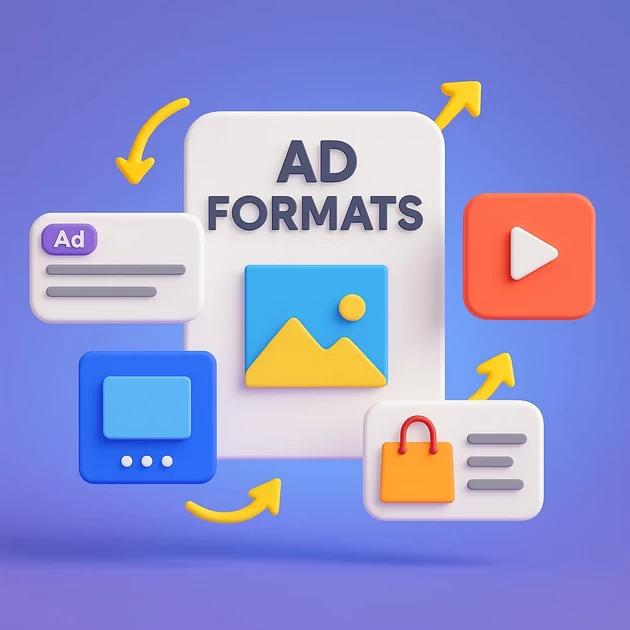
Ad Formats: Complete Guide to Types, Strategy, Benefits & Optimization in Digital Marketing
Every platform in digital marketing—Google, Facebook, Instagram, YouTube, and Display Networks—depends heavily on Ad Formats.No matter how good your targeting...
-
by
-
Dec 7, 2025
Every platform in digital marketing—Google, Facebook, Instagram, YouTube, and Display Networks—depends heavily on Ad Formats.
No matter how good your targeting or bidding strategy is, your ad format determines how users see your message.
Digital marketing becomes efficient only when advertisers understand:
✔ how ad formats work
✔ why platforms create multiple formats
✔ how different formats match user intent
✔ which formats maximize CTR and conversions
✔ what mistakes to avoid
This guide gives you a complete conceptual understanding of ad formats without overwhelming technical jargon.
What Are Ad Formats? (Conceptual Explanation)
Ad Formats are predefined structures or frameworks that determine how an advertisement appears to the user.
Each format has a specific purpose based on:
- user behavior
- platform layout
- content type
- screen size
- intent level
- visual engagement
At its core:
Ad Format = The structural shape your advertisement takes.
In digital marketing, choosing the right ad format is as important as choosing the right audience. The format defines how the message enters the user’s mind.
Why Ad Formats Are Important in Digital Marketing (Conceptual Explanation)
- Different users need different communication styles
Some users prefer text, some images, some video, some short format, some long format.
- Platforms behave differently
Google Search shows text.
YouTube prefers video.
Instagram loves images and reels.
Facebook supports mixed formats.
- Intent varies by platform
Search = high intent
Social media = low to medium intent
Display = awareness intent
YouTube = storytelling intent
- Formats influence how quickly a user processes information
Short formats deliver fast attention.
Detailed formats deliver deep persuasion.
- Formats impact CPC, CTR, and conversion rate
A mismatch between format and user intent weakens performance.
Thus, Ad Formats are not design choices—they are strategic decisions in digital marketing.
Types of Ad Formats (Complete Breakdown Across Platforms)
Below is a deeply conceptual explanation of every major ad format used in digital marketing.
⭐ 1. Search Ad Formats
A. Text Ads
Appear in Google Search results.
Purpose:
Deliver direct answers for high-intent searches.
Why it works:
User is already searching → text gives clarity → high CTR.
B. Responsive Search Ads (RSA)
Google automatically mixes headlines & descriptions.
Purpose:
Match search queries more accurately.
Why it matters in digital marketing:
Better matching → better relevance → lower CPC.
C. Dynamic Search Ads (DSA)
Google auto-generates headlines using website content.
Purpose:
Great for sites with many pages.
Concept:
Platform takes control to match long-tail searches better.
⭐ 2. Display Ad Formats
Display ads are visual and appear across websites & apps.
A. Banner Ads
Static image ads placed on websites.
B. Responsive Display Ads (RDA)
Google automatically adjusts ad shapes.
C. Rich Media Ads
Interactive ads that include animations or motion.
D. Native Ads
Blend into website content.
Conceptual Insight:
Display formats work best in awareness-stage digital marketing because users are not actively searching.
⭐ 3. Video Ad Formats
Mostly used on YouTube, Facebook, Instagram.
A. Skippable Video Ads
Viewer can skip after 5 seconds.
B. Non-Skippable Ads
Must be watched fully.
Ideal for brand recall.
C. Bumper Ads
6-second short ads.
D. In-feed Video Ads
Appear in YouTube search or homepage.
Concept:
Humans react stronger to movement → video formats trigger emotional response → stronger persuasion.
⭐ 4. Social Media Ad Formats
Platforms like Meta (Facebook/Instagram) have diverse formats due to visual nature.
A. Image Ads
Single static image.
B. Video Ads
Short or long videos.
C. Carousel Ads
Multiple images users can swipe.
D. Collection Ads
Show product catalogs.
E. Stories/Reels Ads
Full-screen vertical video.
Concept:
Social ad formats depend on immersion — the more immersive the format, the stronger the digital marketing impact.
⭐ 5. Shopping Ad Formats
Used in Google Shopping.
A. Product Shopping Ads
Show product image, price, brand.
B. Showcase Shopping Ads
Show collections for generic searches.
Concept:
Visual decision-making improves shopping experience → reduces search friction.
⭐ 6. Performance Max Ad Formats
Google uses multiple formats automatically:
- search
- display
- video
- shopping
- discovery
Concept:
AI selects the best format for each placement → maximizing digital marketing efficiency.
⭐ 7. App Promotion Ad Formats
Used for driving app installs.
A. App Install Ads
One-click install buttons.
B. App Engagement Ads
Encourage app usage.
How Ad Formats Influence User Behavior (Conceptual)
Ad formats influence:
✔ attention
✔ emotional response
✔ trust perception
✔ clarity
✔ purchase intent
Digital marketing depends heavily on these psychological triggers.
Text formats → logical processing
User reads and evaluates.
Image formats → instant attention
Visuals communicate faster.
Video formats → emotional processing
Best for storytelling and persuasion.
Carousel formats → exploration behavior
User interacts → higher engagement.
Selecting the correct format aligns the message with the mindset of the user.
Choosing the Right Ad Format (Conceptual Strategy)
The right format depends on:
1. User Intent
High intent → search ads
Low intent → display ads
Emotional intent → video ads
2. Funnel Stage
Awareness → video, display
Consideration → carousel, image
Conversion → search, shopping
3. Device Type
Mobile → short vertical formats
Desktop → detailed formats
4. Message Complexity
Simple message → image or text
Detailed message → video or carousel
5. Objective
Leads → search + responsive ads
Sales → shopping + remarketing
Branding → video + display
⭐ What We SHOULD Do
✔ Choose ad formats aligned with user intent
✔ Use responsive formats to adapt automatically
✔ Test multiple creative styles
✔ Use vertical videos for mobile users
✔ Align landing pages with ad formats
✔ Use strong headlines for text formats
✔ Keep image ads clutter-free
✔ Use carousel formats for product showcases
✔ Use video formats for brand storytelling
✔ Analyze performance per format weekly
⭐ What We SHOULD NOT Do
❌ Don’t use the same ad format for all audiences
❌ Don’t upload low-quality images or videos
❌ Don’t ignore mobile users
❌ Don’t run display ads for high-intent keywords
❌ Don’t create overly complex ads
❌ Don’t rely only on one ad format
❌ Don’t ignore platform guidelines
❌ Don’t use too much text in image ads
Many students learn the practical application of ad formats in a Digital Marketing Course in Trichy, including creative strategy and optimization.
1. What are ad formats in digital marketing?
Ad formats are predefined structures that determine how an advertisement appears on a platform. They include text ads, image ads, video ads, carousel ads, display ads, shopping ads, and more.
2. Why are ad formats important?
They influence visibility, engagement, CPC, CTR, and conversion rates. Choosing the right format improves digital marketing performance.
3. Which ad format is best?
The best format depends on objective:
- Search → Text ads
- Branding → Video
- Ecommerce → Shopping
- Awareness → Display
- Product exploration → Carousel
No single format suits all goals.
4. Do ad formats affect Ad Rank?
Yes. Ad formats like responsive search ads and extensions influence expected CTR, which improves Ad Rank.
5. Are video ads better than image ads?
Video ads are better for emotional storytelling and awareness, while image ads work well for simple messages and quick conversions.
6. Can ad formats reduce CPC?
Yes. Relevant and user-friendly ad formats improve Quality Score, which lowers CPC.
7. How many ad formats should I use?
Use multiple formats and let the platform optimize delivery. Mixed-format digital marketing campaigns always perform better.
8. Do different platforms require different formats?
Yes. Google Search, YouTube, Instagram, and Display networks have unique formats designed for their users.
9. Should I use responsive formats?
Absolutely. Responsive formats adapt to different placements and devices automatically, improving reach and performance.
10. What happens if I choose the wrong ad format?
Your ad may get lower engagement, higher CPC, poor conversions, and wasted budget — a common issue in digital marketing.
-
AboutBIT

You May Also Like
Sign up to receive our latest updates
[mc4wp_form id=3101]
Get in touch
Address
152A, Annavalaivu, Thuvakudimalai, Tiruchirappalli, Tamil Nadu – 620 022
Landmark : Near Post Office
Landmark : Near Post Office
bloomingtutorial@gmail.com
