Ad Extension: Meaning, Types, Benefits, and Conceptual Explanation for Digital Marketing
In digital marketing, the biggest challenge advertisers face is simple: Everyone is competing for the same user’s attention. Search ads...
-
by
-
Dec 7, 2025
In digital marketing, the biggest challenge advertisers face is simple:
Everyone is competing for the same user’s attention.
Search ads appear in limited positions, and thousands of businesses want those top spots.
Ad Extensions were created to solve this problem by making ads:
- larger
- more relevant
- more informative
- more useful
Ad Extensions are not optional anymore. They are a core part of Google Ads and modern digital marketing strategy.
Without them, your ad is incomplete.
This guide explains conceptually, not just definition-based, what Ad Extensions truly are and why Google values them so highly.
What Is an Ad Extension? (Conceptual Explanation)
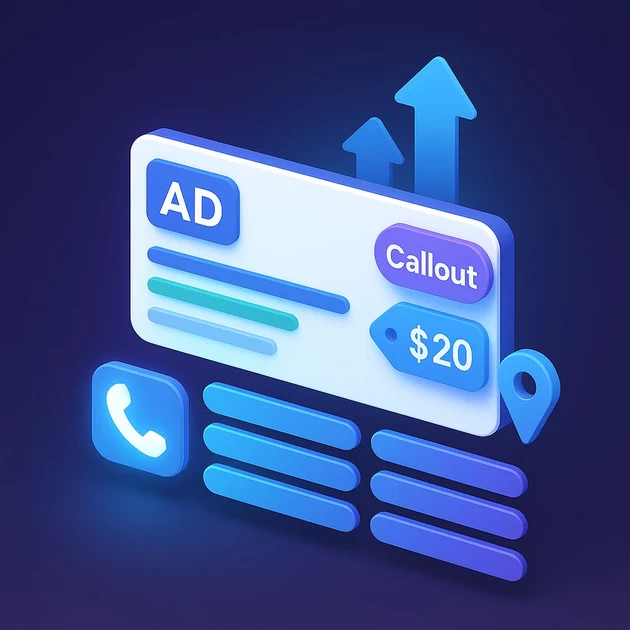
Ad Extensions are additional components that expand your search ads with extra information to improve clarity, relevance, and usefulness for the user.
✔ They do NOT change your main ad.
✔ They simply enhance it.
The philosophy behind ad extensions is simple:
Users make decisions based on information.
More useful information = Better decision = Higher engagement.
Google’s search results page is extremely competitive.
When your ad includes more meaningful information, it stands out and attracts more high-intent clicks.
From a digital marketing point of view:
- they reduce unnecessary clicks
- they improve click-through rate (CTR)
- they communicate value faster
- they make the ad more aligned with user intent
Google’s systems evaluate ads not only based on bidding but also on ad usefulness, and extensions strongly contribute to this usefulness.
Why Ad Extensions Exist (The Concept Behind Google’s Logic)
Google ads exist to connect the right user to the right business.
For this to happen efficiently, Google needs advertisers to provide more structured and relevant information.
Ad Extensions help Google achieve these goals:
- Improve user experience
Users want quick answers, direct access, clear navigation, and relevant offers.
- Increase ad relevance
Extensions allow advertisers to give Google more context.
- Improve ad performance
Higher relevance → Higher predicted CTR → Higher Ad Rank.
- Reduce ad cost for quality advertisers
When your ad becomes more appealing, Google rewards you with lower CPC.
- Standardize digital marketing formats
Extensions create uniform structures that Google can understand, score, and deliver effectively.
In short:
Ad Extensions help Google trust your ad more.
And trust is everything in digital marketing.
How Ad Extensions Affect Ad Rank
To understand why Ad Extensions are powerful, we must understand the Ad Rank formula.
Google calculates Ad Rank using:
- Bid amount
- Quality Score (CTR, relevance, landing page experience)
- Expected impact of extensions and formats
The third point is where Ad Extensions become a strategic advantage.
✔ They increase predicted engagement
Google values ads that users are more likely to interact with.
✔ They enhance relevance
Structured information increases alignment with user search intent.
✔ They increase ad visibility
Larger ads = more attention.
✔ They contribute to higher Quality Score
Better user experience = better QS.
This creates a feedback loop that benefits digital marketing:
Extensions → Higher CTR → Higher Quality Score → Lower CPC → Better ranking
Even with a lower bid, advertisers using high-quality extensions can win the auction.
Types of Ad Extensions (Detailed Conceptual Breakdown)
Below is an expanded conceptual explanation of each major extension — focusing on why they exist and how they support digital marketing strategy.
⭐ 1. Sitelink Extensions
Adds additional links below the main ad.
Conceptual Value:
They help users skip unnecessary steps.
Instead of landing on the homepage, users can choose exactly where they want to go.
This reduces friction and increases relevance — a core digital marketing goal.
⭐ 2. Callout Extensions
Short descriptive phrases that highlight strengths.
Examples:
- Free Trial
- Money-Back Guarantee
- 24/7 Support
Conceptual Value:
They give users a quick summary of your value proposition.
These are not clickable but influence perception.
In digital marketing, perception drives clicks.
⭐ 3. Structured Snippet Extensions
Lists predefined categories like:
- Services: SEO, PPC, SMM
- Courses: Python, Java, PHP
Conceptual Value:
They allow you to communicate service depth and options.
This improves both relevance and user understanding.
⭐ 4. Call Extensions
Adds your business phone number.
Conceptual Value:
This supports intent-driven digital marketing.
Users who want immediate solutions prefer direct calling.
⭐ 5. Location Extensions
Displays your business location and distance.
Conceptual Value:
Supports local search behavior.
Users often choose nearby businesses first.
⭐ 6. Price Extensions
Show product or service pricing.
Conceptual Value:
Removes uncertainty and filters out low-intent users.
Brings more qualified clicks, reducing wasted spend in digital marketing.
⭐ 7. Promotion Extensions
Show offers and discounts.
Conceptual Value:
Communicate urgency and value instantly.
Google wants ads that move the user toward action faster — extensions do exactly that.
⭐ 8. App Extensions
Promote app downloads.
Conceptual Value:
Suitable for digital marketing campaigns focused on app growth.
Reduces friction by linking directly to app stores.
How Ad Extensions Fit Into Digital Marketing Strategy
Ad Extensions are not just an addition — they are a strategic optimization tool.
Here’s how they support digital marketing:
✔ They increase CTR
Higher CTR improves Quality Score.
✔ They reduce CPC
Better Quality Score → Lower cost.
✔ They improve user flow
Extensions guide users to more relevant pages.
✔ They increase ad size
Larger ads visually dominate the search results.
✔ They reveal more about your offerings
Google Ads becomes a mini-landing page.
✔ They reduce unqualified traffic
Right information attracts right users.
✔ They provide more structured data to Google
Better data → Better algorithm decisions.
What We SHOULD Do (Strategic Best Practices)
✔ 1. Use at least 4 extensions
More extensions → more ad coverage → more interactions.
✔ 2. Write short and meaningful callouts
Clarity wins over creativity in digital marketing.
✔ 3. Keep all extension information updated
Expired offers hurt performance.
✔ 4. Make sure extensions are relevant to your keywords
Relevance is the foundation of Quality Score.
✔ 5. Use structured snippets to showcase variety
This improves perceived value.
✔ 6. Use price extensions only when transparent
Accurate pricing builds trust.
✔ 7. Match extension types with user intent
High-intent users respond well to price and promotion extensions.
✔ 8. Ensure landing pages align with extension information
Consistency improves Ad Rank.
✔ 9. Test extension combinations
Some extensions work better for certain industries.
What We SHOULD NOT Do
❌ 1. Do not add unnecessary links
Irrelevant sitelinks confuse users.
❌ 2. Do not reuse same text everywhere
Each extension must add new value.
❌ 3. Do not use long sentences
Extensions should be crisp and impactful.
❌ 4. Do not misrepresent information
This leads to poor Quality Score and policy violations.
❌ 5. Do not ignore mobile formatting
Most digital marketing traffic is mobile.
❌ 6. Do not rely only on automated extensions
Manual extensions give more control.
❌ 7. Do not use all extensions blindly
Select based on campaign goals.
Quick Conceptual Case Study
Advertiser A (No Extensions)
- Ad looks small
- CTR is low
- Quality Score average
- CPC high
Advertiser B (Using 5 Extensions)
- Larger ad
- Higher CTR
- Higher Quality Score
- Lower CPC
- More conversions
Even with a lower bid, Advertiser B wins.
This demonstrates how powerful ad extensions are in digital marketing.
Many learners understand the practical use of ad extensions and bidding strategy through a Digital Marketing Course in Trichy, where hands-on Google Ads training is provided.
Conclusion — Ad Extensions Are Strategic Tools, Not Decorations
Ad Extensions are not optional add-ons.
They are critical components that:
✔ communicate more value
✔ enhance user decision-making
✔ support ad rank
✔ reduce cost
✔ increase CTR
✔ improve conversion quality
✔ strengthen digital marketing efforts
Conceptually, Ad Extensions transform your ad from a simple message into a complete information unit that serves the user better.
And when users are better served, Google rewards you with:
- better position
- lower cost
- higher engagement
Ad Extensions are one of the simplest yet highest-impact tools in the entire digital marketing ecosystem.
1. What is an Ad Extension in Google Ads?
An Ad Extension is an additional piece of information added to a Google search ad. It helps expand the ad with meaningful details like sitelinks, call buttons, location, pricing, or offers. Conceptually, ad extensions increase ad usefulness and relevance, which improves advertising performance in digital marketing.
2. Do Ad Extensions improve Ad Rank?
Yes. Ad Extensions are part of Google’s Ad Rank calculation. When extensions increase expected user engagement, Google rewards the ad with higher visibility, better positions, and potentially lower cost per click. This makes ad extensions a strategic part of digital marketing optimization.
3. Are Ad Extensions free to use?
Yes. Google does not charge extra for adding ad extensions. You only pay when a user clicks on your ad or extension link. This is why advertisers in digital marketing use extensions to maximize results without increasing budget.
5. Which Ad Extensions improve CTR the most?
Extensions with the highest impact include sitelinks, callouts, structured snippets, price extensions, and promotion extensions. These extensions increase the size and clarity of your ad, making them more engaging in competitive digital marketing environments.
-
AboutBIT

You May Also Like
Sign up to receive our latest updates
[mc4wp_form id=3101]
Get in touch
Address
152A, Annavalaivu, Thuvakudimalai, Tiruchirappalli, Tamil Nadu – 620 022
Landmark : Near Post Office
Landmark : Near Post Office
bloomingtutorial@gmail.com
