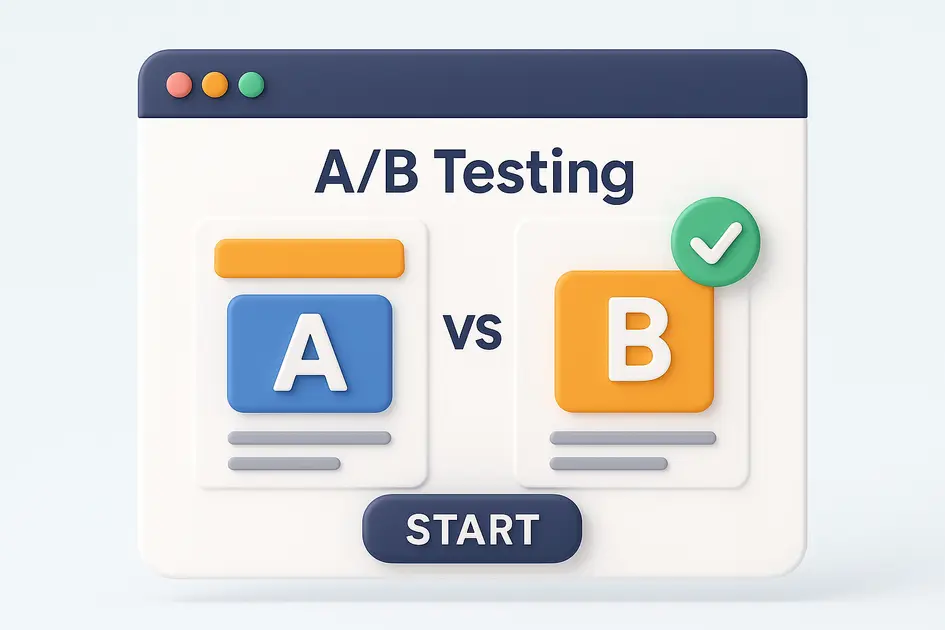
A/B Testing: Meaning, Process, Real-Life Examples, SEO Benefits & Complete Conceptual Guide
-
November 28, 2025
-
by
Introduction — Why A/B Testing Is the Secret Formula Behind Every Successful Business
Every top digital company uses A/B Testing daily:
- Google tests hundreds of layouts every month
- Amazon tests button colors, product titles, prices
- Netflix tests thumbnails and preview designs
- Facebook tests almost everything you see on your screen
- YouTube tests title formats and video layouts
Why?
Because A/B Testing removes guesswork and replaces it with data-backed decisions.
Instead of thinking “This design looks better”, you get to prove which version works better with real users.
✔ Analogy
Imagine you’re cooking biryani for the first time.
You test:
- Version A: more masala
- Version B: less masala
You let your family taste both.
Whichever gets better feedback becomes your final recipe.
That’s A/B Testing in the digital world — testing two versions and choosing the winner.
What Is A/B Testing?
Simple Definition
A/B Testing is a method where you compare two versions of something — Version A (original) and Version B (changed version) — to see which one performs better.
Technical Definition
A/B Testing is a controlled statistical experiment where traffic is split randomly between two variations of a digital element to measure which one delivers higher conversion rates.
Conceptual Understanding
A/B Testing is the science of making decisions based on evidence instead of assumptions.
Analogy: Choosing Between Two Teaching Methods
If a teacher tries two methods —
A: Traditional explanation
B: Activity-based learning
She observes:
Which class understands better?
Which is more engaged?
Whichever method gives better results becomes the final teaching approach.
This is exactly how A/B Testing works online.
Why A/B Testing Is Important
1. Eliminates Guesswork
You don’t need to assume which design or content is better.
You let users decide through real data.
2. Increases Conversions and Sales
Small changes = Big results.
Changing just a button color increased Netflix signups by thousands.
3. Improves User Experience (UX)
Users behave differently than we expect. A/B Testing helps understand their real behavior.
4. Reduces Risk Before Implementing Big Ideas
Before redesigning your entire website, you can test parts of it safely.
5. Saves Money
No wasted spending on designs, ads, or pages that don’t work.
How A/B Testing Works — Step-by-Step Scientific Process
Step 1 — Identify a Problem or Opportunity
Example: Your landing page has a low signup rate.
Step 2 — Create a Hypothesis
A hypothesis is an educated guess.
Example:
“Changing the CTA button text from ‘Submit’ to ‘Get Your Free Course’ will increase conversions.”
Step 3 — Create Variants (A & B)
- A = Control (original)
- B = Variant (modified)
Example:
A: Red button
B: Green button
Step 4 — Split Traffic Randomly
Half users see A
Half users see B
This must be random to avoid bias.
Step 5 — Collect Data for Enough Time
Run the test long enough to get statistically significant results.
Step 6 — Analyze Results
Which version performed better?
Metrics you analyze:
- Click-through rate
- Signup rate
- Sales
- Bounce rate
- Time spent
Step 7 — Apply the Winning Version
The winning version becomes your final permanent page.
What Elements Can You A/B Test? (Beginner to Advanced)
Think of your website as a shop:
Every element can influence customer decisions.
Website Elements You Can Test
- Headlines
- Button color
- CTA text
- Images
- Videos
- Page layout
- Fonts
- Testimonials
- Pricing tables
- Landing pages
- Forms
A/B Testing in Email Marketing
- Subject lines
- Preview text
- Sender name
- Design
- CTA placement
A/B Testing in Online Ads
- Ad copy
- Headline
- Thumbnail
- Audience targeting
A/B Testing in Mobile Apps
- Onboarding process
- Menu design
- Feature placement
Analogies to Understand A/B Testing Perfectly
1. Two Shop Signboards
Shop owner tests:
A: Yellow board
B: Red board
Whichever attracts more customers = winner.
2. YouTube Thumbnail Testing
Creators upload:
A: Normal thumbnail
B: Emotional close-up thumbnail
One gets more clicks → that becomes final.
3. WhatsApp DP Testing
One DP → 40 reactions
Other DP → 100 reactions
Winner is obvious.
A/B Testing Examples from Real Companies
Example 1 — Amazon’s Button Test
Amazon tested button color variations.
Even a small change improved conversions massively.
Example 2 — Netflix Thumbnails
They show different thumbnails to different users.
Whichever gets more views wins.
Example 3 — Facebook Signup Page
Small layout changes increased signups dramatically.
Example 4 — Email Marketing Subject Line Test
A: “Get Discount Today”
B: “Your 20% Discount Is Ready!”
B gets more opens.
Winner = B.
Tools for A/B Testing (Free & Paid)
Free Tools
- Google Optimize (legacy)
- Zoho PageSense
- Microsoft Clarity
- Hotjar heatmaps
Paid / Professional Tools
- Optimizely
- VWO
- Convert
- Adobe Target
Heatmaps & Behavior Tools
- Hotjar
- CrazyEgg
Useful for understanding user behavior before testing.
Mistakes to Avoid in A/B Testing
Testing Too Many Changes at Once
Change only one element at a time.
Ending the Test Too Soon
Wait for enough data.
Testing Without Proper Traffic
Low traffic = inaccurate results.
Running Multiple Tests on Same Page
Creates conflicting outcomes.
Forgetting Your Hypothesis
Every test must have a clear reason.
A/B Testing vs Multivariate Testing — Clear Difference
A/B Testing = Two versions → One change
Multivariate = Many combinations → Multiple changes tested at once
Use multivariate only if you have high traffic.
Understanding Statistical Significance (Explained Simply)
Imagine flipping a coin.
If you flip only 2 times and get 2 heads, you might wrongly think the coin is magic.
But if you flip 200 times, results stabilize.
This is statistical significance.
Meaning:
You need enough traffic to trust A/B test results.
User Psychology Behind A/B Testing
Things that affect user decisions:
- Colors
- Emotions
- Fear of missing out (FOMO)
- Trust badges
- Layout clarity
- Simplicity
- Social proof
A/B Testing helps you understand psychological triggers.
Industry-Specific A/B Testing Strategies
For E-Commerce Stores
- Product page layout
- Checkout buttons
- Pricing display
For Education Websites (Your Field)
- Course page arrangement
- Demo video banner
- CTA text (Join Free Class vs Book a Demo)
For Service Websites
- Hero section design
- Testimonials
- Contact form length
A Complete A/B Testing Case Study (Story Style)
Scenario:
A coaching institute landing page has low conversion.
Problem:
Only 3% users fill the form.
Hypothesis:
Changing the button text from “Submit” to “Get Free Demo Class” will increase signups.
Test:
A: Submit
B: Get Free Demo Class
Traffic: 10,000 visitors
Result:
A → 3% conversion
B → 5.2% conversion
Conclusion:
B increased conversions by 73%.
Frequently Asked Questions (FAQ)
✔ How long should an A/B test run?
At least 1–2 weeks or until statistical confidence is reached.
✔ Can small websites do A/B Testing?
Yes, but results may take longer.
✔ What is the best element to test first?
Usually headlines and CTA buttons.
✔ Should I test multiple elements together?
No, that becomes multivariate testing.
Conclusion — A/B Testing Is Experimentation, Not Guessing
A/B Testing is the backbone of digital success.
It helps you:
- Understand user behavior
- Increase conversions
- Improve the user experience
- Reduce risk
- Make scientific decisions
Whether you’re running a blog, course website, e-commerce store, or marketing campaign — A/B Testing gives you the power to grow confidently.
-
byBIT
-
November 28, 2025
You May Also Like
-
Nov 28, 2025
Introduction — Why 404 Pages Matter More Than Website Owners Realize The 404 page error is one of the most...

-
Oct 6, 2025
Many people want to know how to connect Instagram to Facebook Page without password, but they don’t know how to...

-
Sep 29, 2025
How to Add AdSense Inside Posts (Elementor) ✅ Option 1: Manually Insert Ads Copy your AdSense ad unit code (e.g.,...

-
Sep 15, 2025
Are you confused about Razorpay Key ID vs Merchant ID? You are not alone. Many beginners face the same doubt...
Sign up to receive our latest updates
[mc4wp_form id=3101]
Get in touch
Address
152A, Annavalaivu, Thuvakudimalai, Tiruchirappalli, Tamil Nadu – 620 022
Landmark : Near Post Office
Landmark : Near Post Office
bloomingtutorial@gmail.com
